
Houston
Operators, CIOs and Microsoft's industrial leaders at the Microsoft Innovation Hub: six talks and a live demonstration on real plant data.
- Date
- Wednesday, 4 November 2026
- Time
- 9:00 AM to 2:00 PM CT. Registration and breakfast from 8:20 AM.
- Venue
- Microsoft Innovation Hub
- Address
- 750 Town and Country Blvd, Suite 1000, Houston, TX 77024
The day
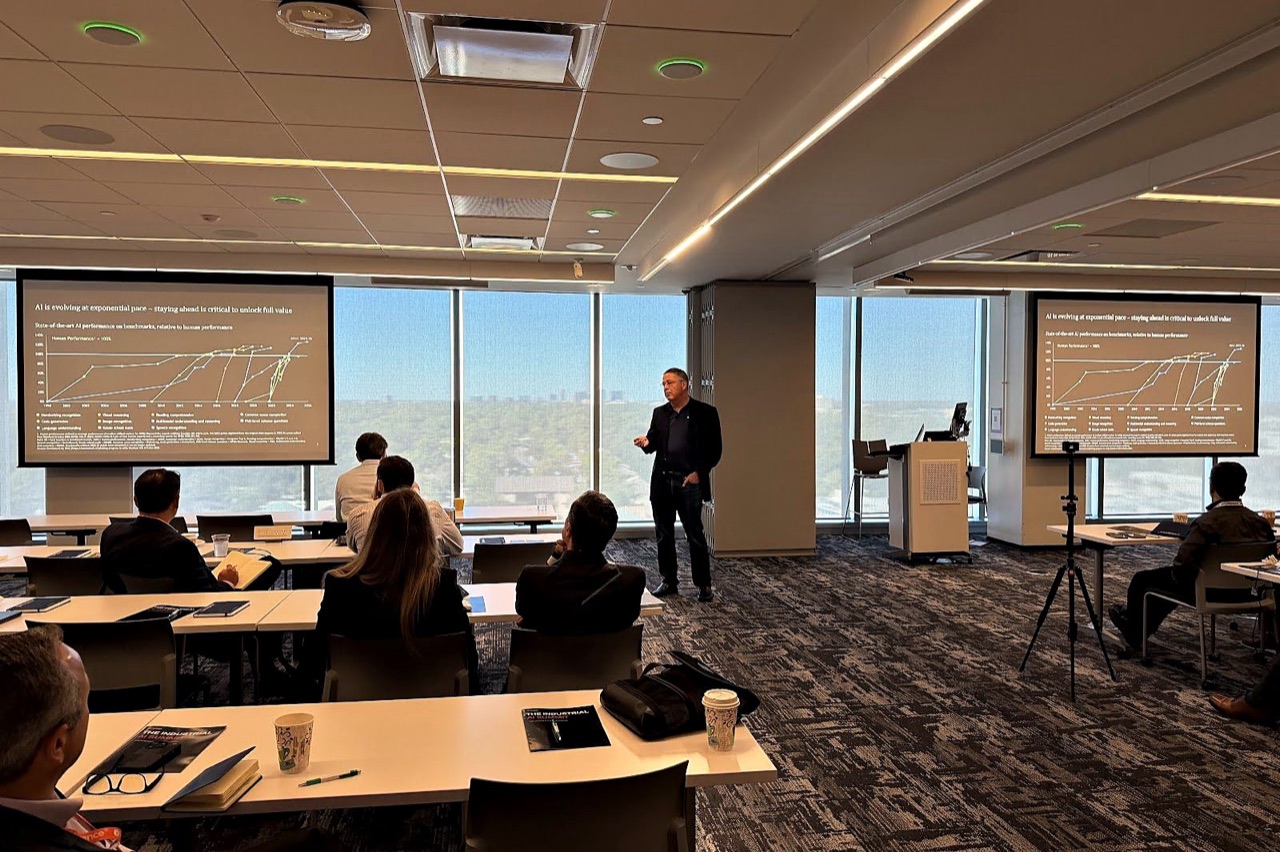
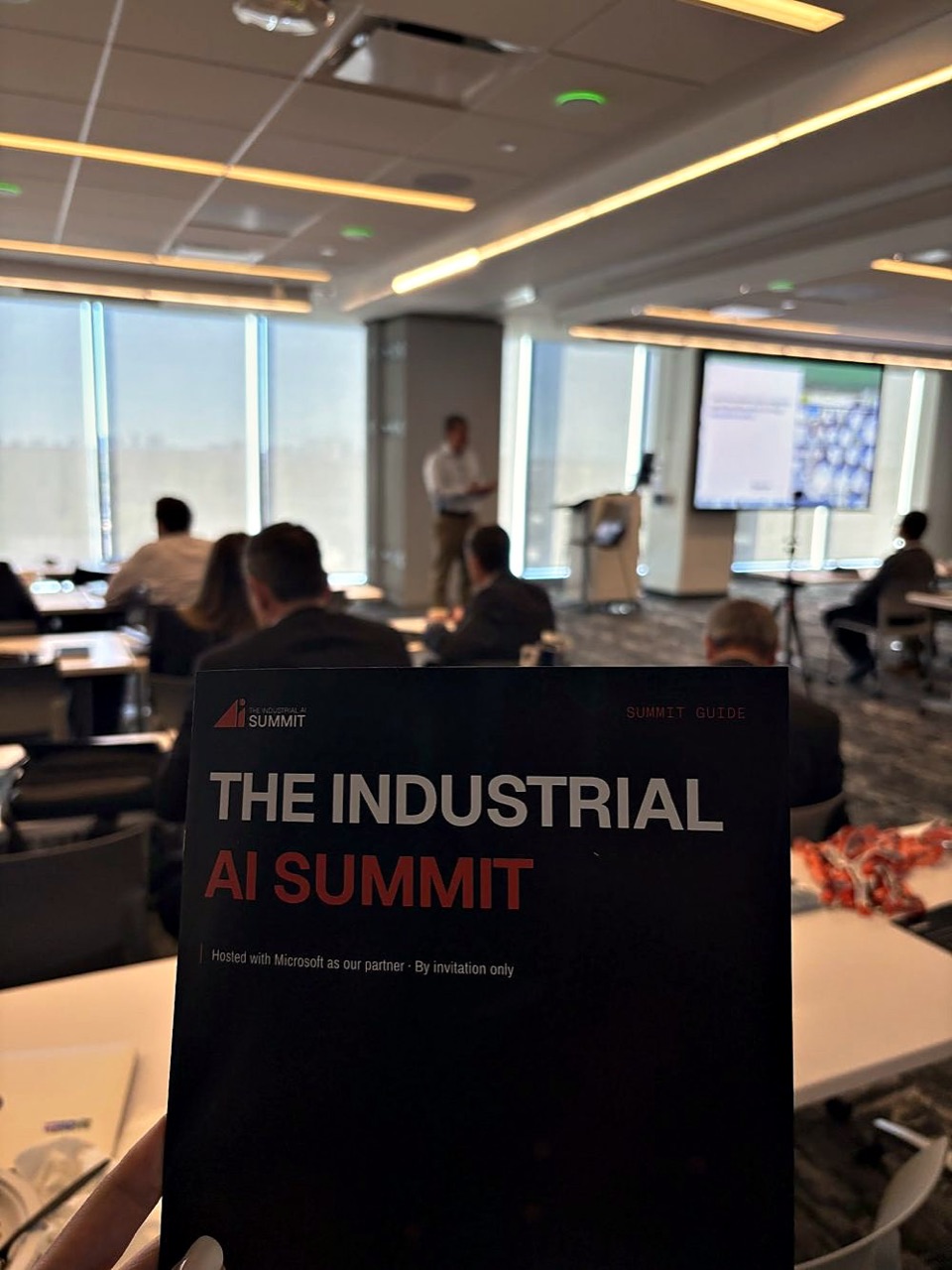
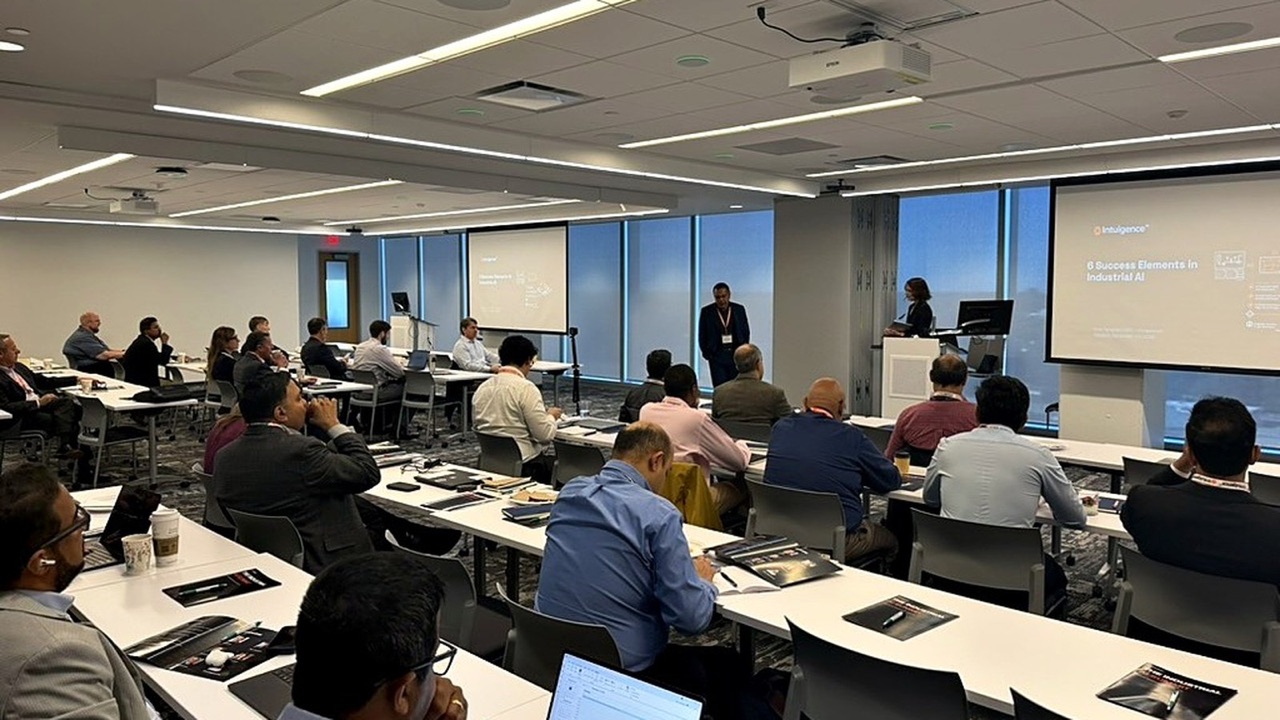
On 4 November, operators, CIOs and Microsoft's industrial leaders filled the Microsoft Innovation Hub in Houston for a day of talks on putting AI to work in industrial operations.
The questions were sharp, the demonstration ran live, and the conversation ran past two o'clock.
Knowledge protection is the key in all of this. Not the models any longer. The models will come and go.
Christoph BerlinVP, Engineering, Microsoft
The talks
-
01
Plant data needs a knowledge graph, not a bigger model.
Opening keynote: Six success elements in industrial AI
What was said
- Onboarding no longer takes a year. Building a knowledge graph for a typical plant of about 500 assets used to take nine to eighteen months. With AI reading the P&IDs, PFDs, time series and tens of thousands of documents, a working graph now takes days.
- Zero egress skips the longest approval cycle. All 17 components, the AI models included, are licensed into the customer’s own Azure tenant. Nothing leaves, so the three to six months of CIO, CISO and legal review that egress triggers never starts.
- Frontier models fall off a modality cliff on plant data, and charge more for it. Models that score 80 to 90 percent on text answered fewer than 10 percent of connectivity questions across 20 P&IDs. Domain-trained smaller models answer at 10 to 100 times lower cost, and a graph answers in milliseconds where a model reasons for minutes.
If you want to build a demo, build it with a large language model. If you want to give it to 50 engineers in the field, build a knowledge graph.
 Moe TanabianFounder and CEO, IntuigenceAI
-
02
Nobody gets to sit this out. Make fewer, bigger bets.
Keynote: Key steps from Chevron’s digital transformation
What was said
- The map changes every six months, so leave markers for each other. Share what is not competitive, and pick up what others have learned. Industry groups that learn together move faster than any company alone.
- Choose your stack, your model strategy and your partners deliberately. The model you use for an HR application is not the one you train on time series, and neither is the one for geology. Different paths need different partners.
- Measure value in a few big bets, not in hours saved. Five hours a week per employee may never show up on the bottom line. The best results, some returning 20 times, come from defined processes with concrete measures, and leading companies make bigger, longer bets there.
Nobody in the industrial space gets to not go on this journey.
 Bill BraunFormer CIO, Chevron
-
03
Protect the knowledge. The models will come and go.
Keynote: Accelerating AI with Microsoft Fabric for industrial use cases
What was said
- It is a mindset, not a technology stack. Every previous revolution changed how work is done, and this one is no different. At a Stuttgart automaker, root-cause investigations that took nine months, mostly spent finding who held the data, now point teams to the evidence in minutes.
- Let the data stay where it is. Put one layer of governance over it. Fifty databases are not the problem; fifty ways of managing them are. A unified data layer, Microsoft Fabric among others, manages and gates them in one way, on premises included.
- Draw the line at your digital estate. Every AI solution either sits inside your tenancy, within your trust and knowledge boundary, or outside it, where someone else has access to your knowledge. Keep operational and institutional knowledge inside, and never expose it to the models.
Knowledge protection is the key in all of this. Not the models any longer. The models will come and go.
 Christoph BerlinVP, Engineering, Microsoft
-
04
Ask the AI engineer for finished work, not an answer.
Product talk and live demo
What was said
- The drawing became a graph while the room watched. Added from the data lake to IntuigenceAI’s workload in Microsoft Fabric, a raw P&ID was parsed into symbols, lines and tags with every connection kept. The same drawing in a general-purpose model scores under 10 percent once 20 P&IDs are in context.
- A team of AI engineers traced a cold column to its likely cause. A plant engineer agent routed the question to the chemical, mechanical, E&I, APC and maintenance specialists. They found the instruments and alarm limits, the two steam reboilers, and on a phone call named the flooded condensate drum starving one of them.
- One request became a repeatable workflow. Troubleshoot the column, notify the shift engineer, raise a work order, alert below set point: planned from the graph, scheduled every six hours, shared as a template. The agents also join Microsoft Teams calls.
The difference is accuracy, latency, cost, and finished work as opposed to “Chat AI”. You don’t just ask it questions, you ask it to perform the work.
 Pegah ZareiVP of Product, IntuigenceAI
-
05
The race is not who can build it. It is how to get to value first.
Keynote: Physical AI outcomes
What was said
- Chatting with your data was phase one. Phase two is the income statement. That only happens when a workflow runs end to end across departments and the organization flattens around it. One company put one person from each system in a room and asked how a startup would serve its customers, then reorganized around the answer.
- Pilot paralysis is fragmentation in disguise. Each pilot proves something inside one department’s data and application, so the value stops at its edge. The magic starts when the departments and their data sets work together.
- Index the data where it sits. Do not lift and shift it. By the time a data lake was aggregated and contextualized, the data was obsolete. Pointing at, mirroring and shortcutting data in place starts a use case in hours. One operator cut 500,000 tons of emissions by putting 250 billion signals to work on its engines.
Don’t go back and let your teams play with it. Run a hackathon, ask them to reimagine a broken process, and have the CEO give the awards.
 Hany SolimanGeneral Manager, Energy and Resources, Microsoft
-
06
AI cost multiplies. Plan it, control it, optimize it.
Keynote: Make your tokens do more for less in industrial AI
What was said
- Four levers multiply, and each can move tenfold. Interactions, agent steps, cost per step and token price. Cloud FinOps fights for 10 to 20 percent; with AI the swing is orders of magnitude, so a plan built from a pilot can be off by ten times.
- A monthly budget is not a control. On a quiet Sunday an agent retrying a failed historian call every ten seconds burned 1.3 billion tokens before anyone read the alert. A circuit breaker that trips within 30 minutes beats a monthly budget by about 1,500 times.
- Spend where a miss is expensive. Route everything else. Grounding a question in a knowledge graph cut it from 150,000 tokens to 7,000. Add model routing and the gap reaches 42 times. Pay for the best model on safety and resiliency calls, and send routine questions to a good-enough one.
If you do the planning wrong you can be off by ten times. If you do control wrong, one Sunday afternoon can ruin your budget. If you don’t optimize, your budget can be fifty times higher than it needed to be.
 Adam BogobowiczSenior Director, Microsoft
The programme
See the programme
- Registration and breakfast
- Welcome and opening remarksPegah Zarei
- Opening keynote: Six success elements in industrial AIMoe Tanabian
- Keynote: Key steps from Chevron's digital transformationBill Braun
- Keynote: Accelerating AI with Microsoft Fabric for industrial use casesChristoph Berlin
- Coffee break
- Product talk and live demonstrationPegah Zarei
- Keynote: Physical AI outcomesHany Soliman
- Keynote: Make your tokens do more for less in industrial AIAdam Bogobowicz
- Closing remarksMoe Tanabian
- Networking lunch
- Program ends
Photographs
On stage